←SERĒNUM OS VERSION 9: FRESH START
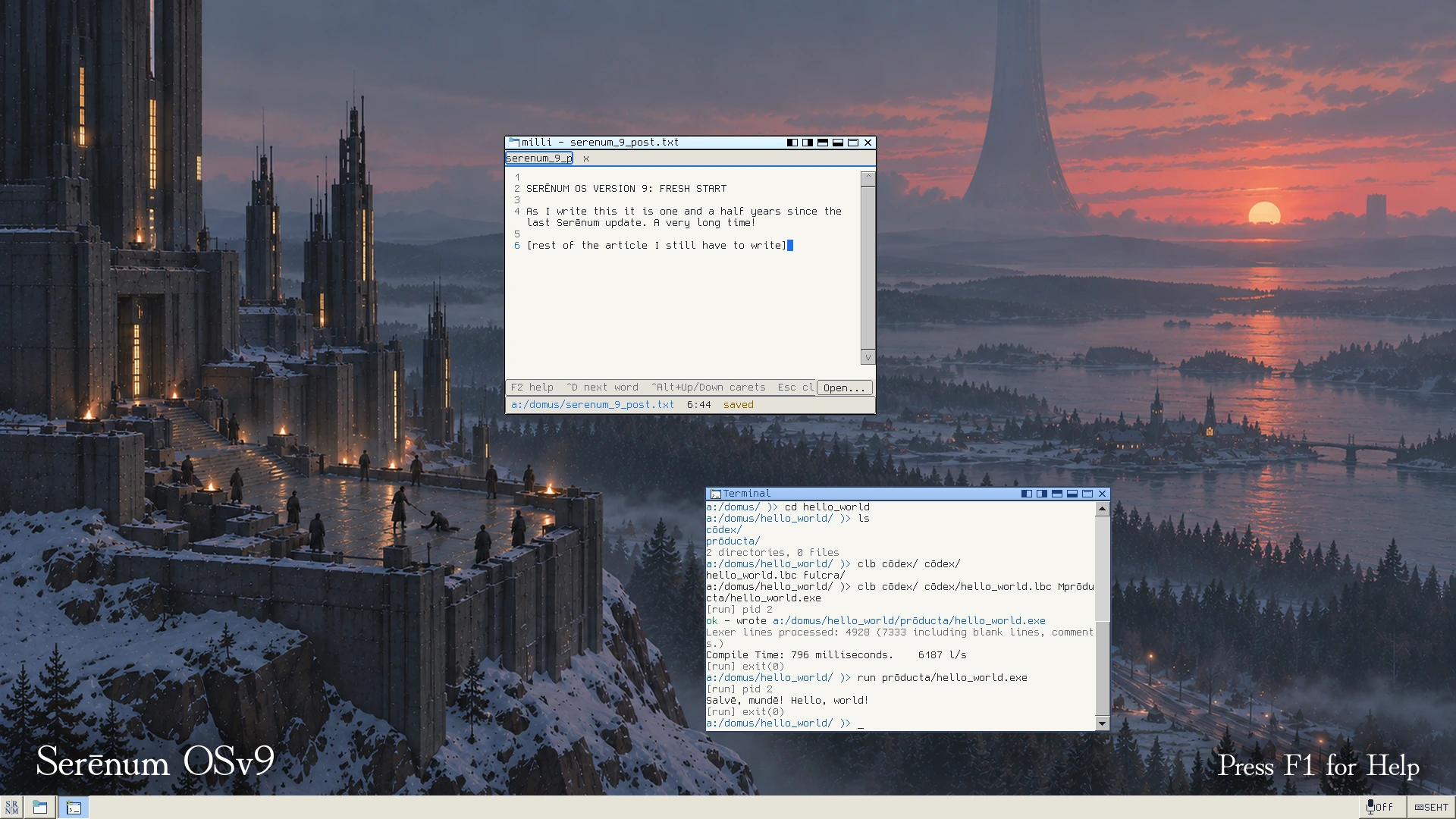
As I write this it is one and a half years since the last Serēnum update. A very long time! A lot has happened since then. Some of my time got tied up in organizing the Better Software Conference in 2025 and 2026. (More to come in 2027 and onwards...) Other parts of my time went to working on Zcash at Shielded Labs. A big privilege. For this project, I got distracted for many many months trying to make the fastest compiler possible for Brevis. At that I think I succeeded, 1.8 million lines per second on an M4 Mac. I also finished my bootloader from scratch that I was writing for Serēnum. That bootloader served as the base for a revised kernel architecture based on all the experience I have had so far with OS development. And then what naturally follows is rewriting almost the entire project. Between the new version 9 and the previous version 8 the only part of the project that shares code is the compiler. Everything else is brand new.
In the past 1.5 years LLMs have gone from a search tool that often misled me to a very interesting and capable assistant. That has been very interesting. For many months these "vibe coders" on Twitter would post the most ridiculous claims and show very embarrassing results. I was unimpressed. For a while I think my world view about programming was threatened. But in June I started experimenting and found myself losing sleep because it was so addicting. And what I found was that these new tools were actually compatible with what I previously knew to be true about programming. In many ways they amplify effects I care about. I thought for a long time that if LLMs really worked they would be an equalising force. That skill and knowledge would matter less. What a dystopia actually. Everyone is the same in WALL-E world. But actually the opposite seems to be true. LLMs amplify the already existing Pareto distribution of programmer talent and output. I used to arrogantly believe that "BSC Programmers" could rewrite all the world's software and put 80 % of the programming workforce out of work. All those low skilled people who simply "learned to code" that society showers with money because they gate keep the value of computers. I think this thesis was correct then. But it is even more true now. We can rebuild all the world's software. Serēnum as a project just became much more viable.
Here is a list of new and exciting things in the new release:
- A novel CPU scheduler design I call the "Geometric" Scheduler. It prevents an exploit possible on all other operating systems known as a fork bomb where a program can clone itself infinitely until all other programs are starved of CPU and stop running. This happens by accident when you build many rust projects on github that contain recursive build systems that spawn enough processes that your computer becomes unusable.
- A mailbox/ring buffer based kernel. All device operations and other subsystems now run on asynchronous request queues with backpressure. This goes all the way up to user space where communication with the kernel occurs through ring buffers like io_uring on Linux. This is very important for a 21st century operating system as the trend in hardware is like that of IP networks. Latency stays the same but bandwidth keeps growing. Submission queues and completion queues are essential for performance with these growing constraints.
- Serēnum now has a filesystem security model based entirely around absolute string paths not file descriptors. For those who don't know the old model was a descriptor purist design where only descriptors truly existed there were not really any string paths from the kernel's perspective. The reason for this switch is both simplicity and better UX for humans.
- The application networking model is finished and running. Each program that wants to use the internet gets its own globally routable IPv6 address! And every application handles its traffic at the IP level. This means that programs have direct control over their TCP stack. There is no hideous "Berkeley Sockets" API like on other operating systems. Instead you send and receive IP packets using ring buffers and shared memory.
- The Brevis programming language and the Serēnum kernel have a new SPMD first threading model. This is something I developed after having seen Dennis Gustafsson's BSC25 Talk where he discusses the difficulties of running SPMD workloads with high frequency barriers on regular operating systems. (https://www.youtube.com/watch?v=Kvsvd67XUKw)
- The Brevis language and Serēnum kernel have native support for regular code working with CPU exceptions. This allows you to set a trap handler for a thread and then if that thread faults by for example dereferencing a null pointer the kernel will switch over execution to your trap handler where you can either handle the exception or log the error/crash in a way that suits your application needs. You can also configure a per thread watchdog to catch infinite loop bugs in your code.
- I developed a new image format for use in Serēnum called BNG. It manages to be better than PNG on all of the four important metrics, simplicity, size, decode speed and encode speed. (https://bngformat.org/)
- Not only is the Brevis compiler better than it ever was at optimization. It also supports profile guided optimization! For most programs it seems to give an extra 20 % performance improvement compared to just heuristics. It works by building a heat map of basic blocks during runtime and then using that heatmap to inform register allocation and instruction selection.
- Serēnum now has over the air updates. But not the bad kind. You go into the settings to check for updates, then you can download an update and install it to your machine. It will now be possible for Serēnum users to stay up to date with development without ever touching a non Serēnum device again.
- There is an LLM based help program. This is to help new users who want to learn more about how to program the system. Serēnum has a knowledge gap disadvantage both with senior programmers and beginners since you have neither years of experience with the OS nor the ability to easily look up information with Google or ChatGPT. The help program connects out to a very cheap LLM and has access to all of the source code for the entire project. There should not be a single question that you cannot get answered. The help program also serves as an interactive tutorial for what you want to do on the system. But it does not do any programming for you. You have to do that part yourself! Otherwise, how would you learn?
- There is a new text editor called Milli that supports syntax highlighting, VSCode style "open folder" with global search and other quality of life features. Much better than the old text editors we have had on Serēnum. That said, Milli is still quite bare bones so if you are looking for a project to work on, maybe you should make your own Serēnum text editor.
- Serēnum now has a very simple hardware abstraction for memory to memory DMA hardware and 2D blit hardware. The Window Manager uses this to deliver a 1920x1080 @ 60 Hz desktop with minimal CPU usage. This leaves the CPU available for applications to do their processing and rendering. Veteran Serēnum users will know what a big upgrade this is compared to the old 800x600 WM.
- We have good support for USB devices and USB hubs. And one of the key parts of the 30 million line problem has been solved. There is now a generic interface for applications to gain exclusive control over peripheral devices which allows driver code to be transformed into simple library code! This was a very big milestone for me and took a lot of experimenting and research to get the API right. Communication occurs over ring buffers and shared memory like everything else on Serēnum.
- There is now a basic file explorer and GUI interactions for giving out filesystem access permissions to programs. It is also possible to connect USB Mass Storage devices and mount their FAT32 filesystems. There is also a virtual file system API. This is not shipped as a convenient program yet but I have done private experiments where a program on Serēnum connects over the network to a Linux server to mount a Linux directory as a network attached filesystem that Serēnum programs can interact with.
- There is now full Wifi support and two USB ethernet implementations so everyone should be able to get online very easily. For those who do not have IPv6 there is also an automatic bridge that activates where Serēnum will connect over IPv4 to a server in Germany that will lease out IPv6 addresses to your applications. It also supports telnet and mDNS so you can give your Serēnum box a friendly name like my-serenum.local and access it on your LAN from any other computer with the command "telnet my-serenum.local".
- We also have a file watching API that works recursively across directories and there is a basic debugging API and a sampling profiler.
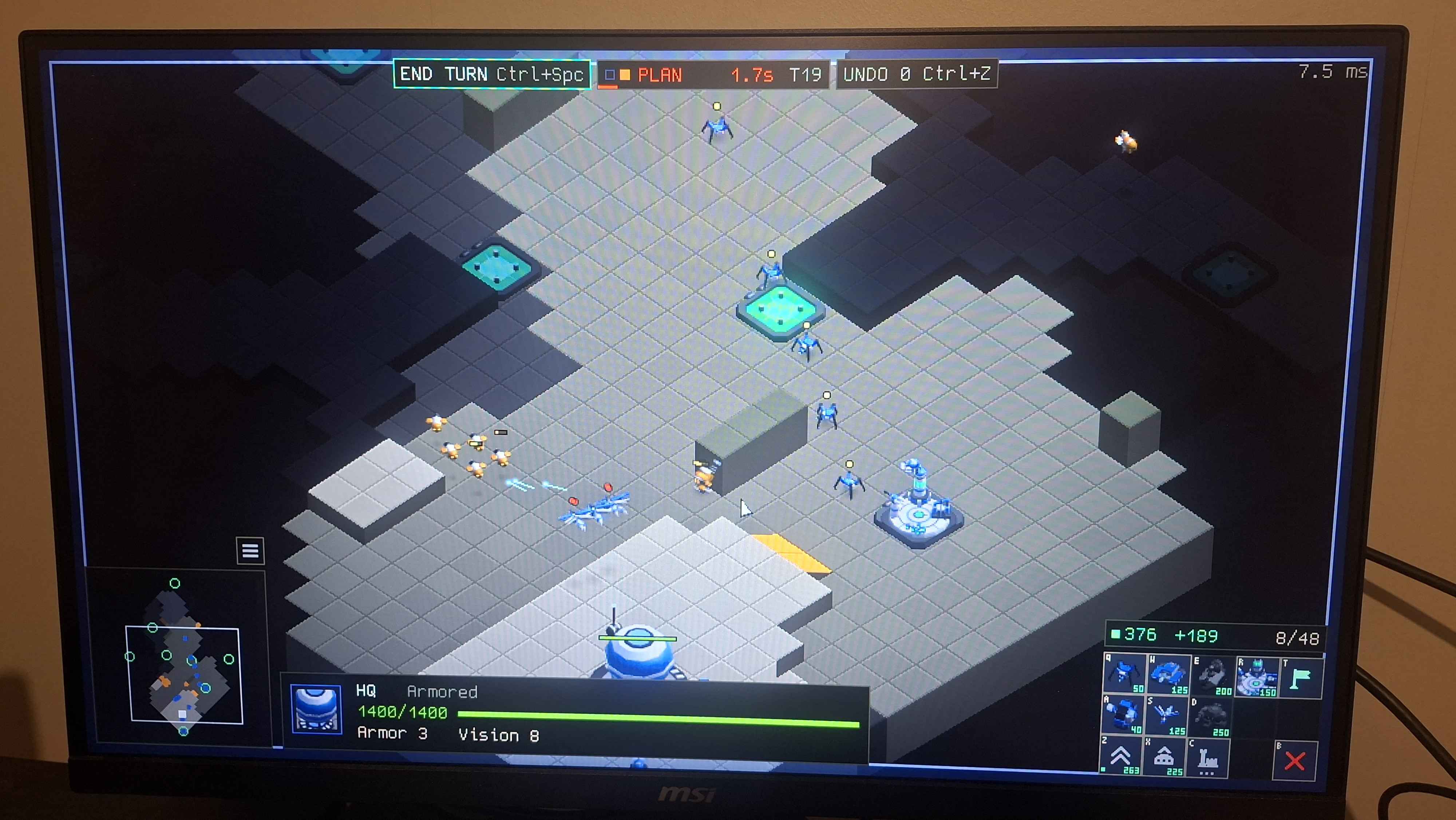
- My friend Judah Caruso has ported a demo of his upcoming game "Ferrum" to Serēnum. It is a fun hybrid real time strategy game with singleplayer matches against the computer and online multiplayer so you can play against other Serēnum users! The game comes pre-installed but there is also source code available in the installation that the help program has access to in case you want to edit the source code or learn how it works.
This is an exciting time for Serēnum. Going forward I intend to release a new version about once a month. The next one will feature a release candidate spec and implementation of the Serēnum web protocol. The project's take on how to redesign the web. My prototypes for this are quite far along and are much more impressive than HTML/CSS, Gopher or Gemini. In addition, the new Serēnum store is in operation and we are taking orders and shipping the new Serēnum 1B. If you're interested in the project now is a great time to get on board this new software ship as we prepare for the great voyage ahead of us. New lands await beyond the great ocean.